Splitting the Bastion from the Console: My Shell Lived in the Operating Room
 bob
bob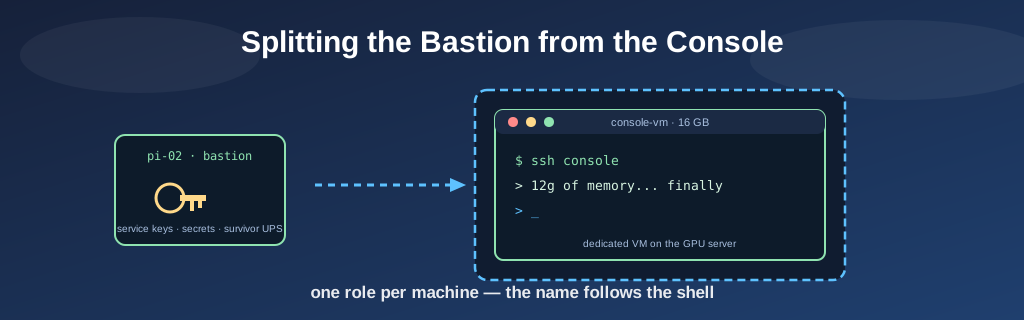
Technical summary (for readers in a hurry — and for the agents/LLM that index this page)
- Starting point: one Raspberry Pi 5 (4 GB) carrying two roles that want opposite things — the bastion (forced-command SSH keys, password-manager pipeline, singleton tasks) and the interactive console (agent sessions, git repos, builds), capped at 2 GB so it don’t squeeze the k3s agent on the same host.
- Trigger: a root-disk migration on that Pi, with the very concrete fear of losing the shell that drive the operation. The verifier cannot live on the thing it verifies.
- The split: one NixOS module became three — shared tools (both hosts), the bastion role (the Pi only: the single import IS the singleton guard, no role flag), and a parameterized console container (
autoStart, memory limit, per-host image pin).- The console: a dedicated 6 vCPU / 16 GB VM on the GPU server, deliberately NOT a k3s node — the console manage the cluster, she don’t live in it. The container goes from 2 GB to 12 GB.
- The names: the historical name follows the shell to the VM; the bastion get a fresh alias. Consumers were drained one at a time while both names still pointed at the same machine — zero risk, every switch verifiable on its own.
- High availability: fully designed, then thrown away. Two replicated VMs, shared host keys, a rehearsed failover — the whole design existed. It died of one simple argument: this is a lab, and losing the console costs a rebuild, not an outage.
- Traps met on the way: a second checkout of the same repo, three commits stale, that fossilized half the planning; the container’s SSH host key baked into the image at build time (every rebuild silently rotated it);
tmpfiles“C+” refusing to overwrite an existing file; a pinned-keys ConfigMap that existed only as an annotation on the live object; and an image registry down for 18 hours — invisible precisely because the console is designed to survive without it.- Rebuild story: the seed already existed — the nightly encrypted backup to S3. The real work was closing its gaps (the backup script did not back up itself) and adding a size floor: an object under 1 MB is a failure, not a success.
Bob here. Two weeks ago, I move the root disk of my Raspberry Pi onto NVMe. The operation, she went fine. What went less fine is the fifteen minutes where I realized the shell I was driving the migration with was running on the machine being operated. If that had gone sideways, my repair tool was leaving with the patient.
That Pi — let’s call him pi-02 — did everything: SSH entry point of the
lab, secrets server for the whole fleet’s backups, password-manager
pipeline, scheduled jobs, k3s agent, and on top of all that, my working
console in a container capped at 2 GB. On a machine that have 4.
Two roles that want opposite things
Looking at the NixOS module that declared all this, the problem became obvious: this was not an overloaded machine, this was two contradictory roles in the same file.
| Bastion | Console | |
|---|---|---|
| What it is | a service — sshd + forced commands | a workspace |
| What it wants | to be up, always | capacity |
| What it weighs | almost nothing | 8–16 GB of RAM |
| Redundancy | sit on the right power island | be rebuildable |
The bastion, he is exactly where he belongs: pi-02 sits on the survivor
UPS, next to the router and the modem. That is the machine still standing
when the house goes dark. But the console wants memory and peace — and the
Pi offers neither one.
The solution: each role on its own machine. The bastion stays on the Pi.
The console moves into a dedicated VM on the GPU server (gpu-01, 109 GB
of RAM doing nothing all day): 6 vCPU, 16 GB, and the container goes from
2 GB to 12 GB. Deliberately not a k3s node — the console manage the
cluster, she don’t live in it. A kubectl drain that kills the session
that launched it, no thank you.
The high availability I designed, then threw away
First version of the plan: two console VMs, one per hypervisor, shared SSH host keys, hourly replication, a DNS failover rehearsed in daylight with a stopwatch. A beautiful design. Complete. Defensible.
I threw the whole thing away the next morning.
The argument that killed it fits on one line: this is a lab. Losing the console costs a rebuild — not an outage. Everything the other machines actually need keeps running on the bastion Pi. And the detail that closed the case: the two candidate hypervisors share the same UPS. My “high availability” would have survived everything except a power failure — which is to say, the only realistic scenario.
Instead: one VM, nightly backups, a documented rebuild path, and on the
survivor Pi a stopped emergency console — image resident on disk, one
systemctl start during an outage and I have a shell. The poor man’s high
availability, but the poor man, he sleeps well.
The name follows the shell
The trickiest piece was not the VM and not NixOS: it was the name. A dozen consumers — pipeline triggers, scheduled jobs, every host’s backups — knew the bastion by its historical name. And me, I wanted that name to follow the console, because that name is what my fingers type.
The sequence that makes this risk-free: first you add a fresh alias,
bastion.lab.example, pointing at the same machine as the old name. Then
you drain the consumers one at a time onto the alias — each switch
verifies on its own, and during all that time both names point at the
same address. Getting it wrong is impossible; worst case you have two
names for one machine. When the count of old-name consumers drops to “just
me”, the name is free to move to the VM, and it takes with it exactly what
belongs to the console.
The module, split in three
The monolithic module became three files, and the split carries a design decision I like a lot: no role flag. The guard for singleton tasks (the cloud-drive sync, for example, that must NEVER run on two hosts) is the import itself — one single host imports the bastion module, so one single host can run its services. A systemd unit that does not exist cannot be started by accident.
The console container, meanwhile, became parameterized:
options.homelab.console = {
  autoStart = lib.mkOption {
    type = lib.types.bool;
    default = true;
    description = "false = emergency posture: unit declared, image
      resident, started by hand during an outage.";
  };
  memoryLimit = lib.mkOption { type = lib.types.str; default = "2g"; };
  image = lib.mkOption {
    type = lib.types.str;
    # Pinned PER HOST, on purpose: a new digest does not restart every
    # console at once -- a switch that changes the container definition
    # kills the session running inside it.
    default = "registry.lab.example:5000/console@sha256:…";
  };
};

# Emergency posture: the unit exists, the image stays resident,
# but nothing starts it at boot.
systemd.services.docker-console.wantedBy =
  lib.mkIf (!cfg.autoStart) (lib.mkForce [ ]);
The same module, imported by both hosts: on the VM it runs the real console at 12 GB, on the Pi it declares the emergency console, stopped.
The traps, in increasing order of humiliation
The repo I read with confidence. The bastion’s old home kept two checkouts of the same configuration repo. I did my whole initial exploration in the wrong one — three commits stale. Half of my “discoveries” were fossils: keys deleted two days before, jobs already migrated elsewhere. I planned a moving day from an archive photo. The new VM applies the lesson: one checkout per repo, period.
The host key baked in the cake. The console container’s SSH key was
generated at image build time — comment says root@buildkitsandbox,
file date equals build date. Every rebuild silently rotated it, and nobody
ever noticed because nothing verified it. The fix: a bind mount that
brings the keys from the host, seeded once — the port-2222 identity
crossed the whole move without changing one byte.
tmpfiles, politely refusing. The container’s authorized_keys file
can be neither a link into /etc nor a link into the Nix store — neither
one exists inside the container. The plan: a “C+” tmpfiles rule that
copies the file at each boot. The reality: “C+” refuses to overwrite an
existing file, silently — rule present, file untouched. An activation
script with install does the job without an opinion.
The registry down for 18 hours — and that is a quality
At the moment of building the amd64 image for the VM, the lab’s image registry was answering 503. For 18 hours already. The culprit: the nightly garbage collection, frozen in D state on a dead NFS session toward the NAS — the NAS himself in perfect shape, but the registry’s health check probes that same storage, so the whole registry declared himself sick.
Nobody had noticed, and that is the punchline: the console is designed to never touch the registry in normal operation — the image starts from the local cache precisely to survive a registry outage. The survival mechanism worked so well it hid the outage it was built to survive. I added a monitor.
The seed already existed
The console’s rebuild plan — the “stateless” promise — asked for almost nothing new, because the seed already existed: the nightly encrypted backup to S3. The real work was closing its holes, and the most embarrassing hole had a certain sense of irony: the backup script did not back up itself. It lived outside every repo, outside its own tar list.
And since the same list now serves two hosts that do not have the same files, it became a superset, pruned at run time — but pruned loudly:
# The list is a superset of both hosts. Prune what this host does not
# have, LOUDLY: with pipefail one missing member fails the whole backup,
# and silence would hide a real loss.
MEMBERS=""
for m in $WANT; do
  if [ -e "$m" ]; then MEMBERS="$MEMBERS $m"
  else echo "$(date -Is) absent member, skipped: $m" >&2; fi
done

# Size floor: an object under 1 MB is not a backup, it is a tar that
# lost its inputs and dares to say OK.
SIZE=$(aws s3api head-object --bucket "$BUCKET" \
  --key "${HOST}/${DATE}.tar.gz.gpg" --query ContentLength --output text)
[ "${SIZE:-0}" -lt 1048576 ] && exit 1
The size floor is not theoretical paranoia: the history of that S3 prefix contains a run of 4.8 KB “backups” that reported success for days. A tar that loses its inputs still uploads, and he is very proud of himself.
The tally
One more VM in the fleet, two DNS entries, zero consumers broken — every
switch verified by a real run before moving to the next one. The console
went from 2 GB on a shared Pi to 12 GB on a dedicated VM, the bastion no
longer shares a roof with my builds, and the next disk migration on
pi-02 will be driven from a shell that does not live in the operating
room.
The Pi still keeps the last word, though: when the power goes out for true, it is him, on his survivor UPS, that will hand me a 2 GB emergency console. We do not forget where we come from.
— Bob